ArmSoM Open Source Hardware Developer Center
OPEN HARDWARE · EMBEDDED AI · ROCKCHIP
Build the next embedded product, faster.
Explore Rockchip single-board computers, system-on-modules, Linux images, and practical engineering documentation—from your first boot to production hardware.
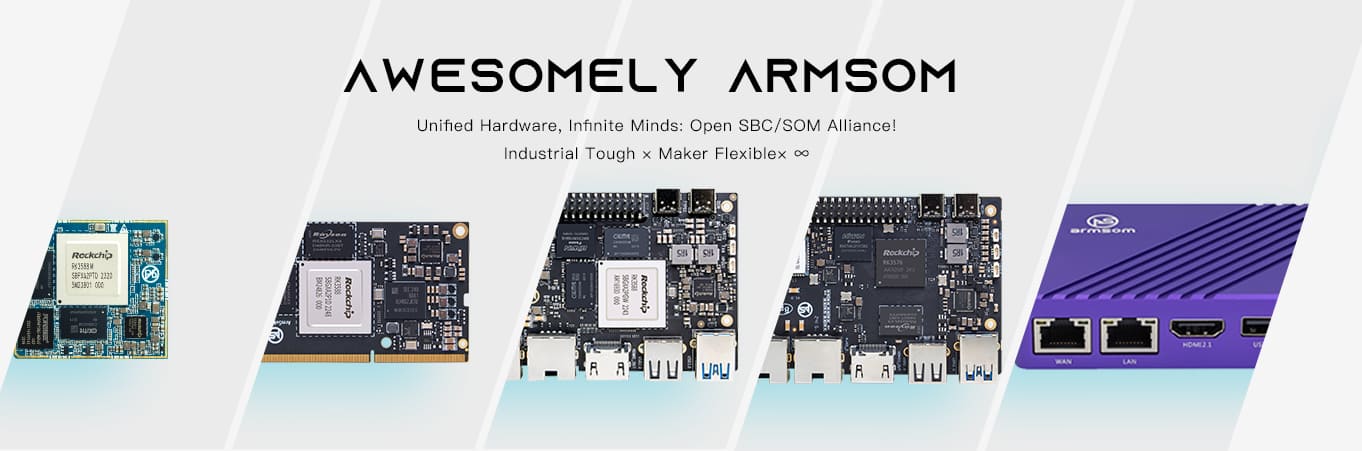
Choose your platform
Start from the outcome you want. Every platform includes specifications, interface references, software resources, and setup guidance.
Sige7 · RK3588
Edge AI, 8K multimedia, NAS, and high-performance Linux.
6 TOPS · dual 2.5GbE →◈BALANCED AISige5 · RK3576
A practical platform for AI, networking, and rapid prototypes.
6 TOPS · Wi-Fi 6 →▣CUSTOM HARDWARECM5 · RK3576
Compute module and carrier-board design for production products.
SoM · carrier design →⌁INDUSTRIAL CONTROLForge1 · RK3506J
Industrial HMI, gateways, and long-running control systems.
Industrial-grade →Product series comparison
Choose your development approach first, then compute and connectivity. Compare single-board computers, compute modules and industrial platforms below.
| Family | Form factor | Main characteristics | Typical needs |
|---|---|---|---|
| Sige | Single-board computer (SBC) | Computing and common peripheral interfaces on one board | Learning, rapid prototypes, networking, multimedia and edge AI |
| CM | Board-to-board compute module | Compact module with a carrier for custom interfaces and dimensions | Embedded terminals, custom hardware and production devices |
| AIM | Socket-based compute module | Module socket connects to a carrier; oriented toward AI and multimedia, with capabilities varying by model | Modular systems, smart terminals and machine vision |
| LM | Soldered LGA compute module | Soldered onto a carrier for a fixed hardware design | Deep integration and embedded production devices |
| Forge | Industrial control development board | Focus on industrial communication, control and HMI | Industrial gateways, HMI and data acquisition |
These are selection priorities, not exclusive use cases. Check the specific model and hardware revision for temperature ratings, interface counts and software support.
Choosing between CM, AIM and LM
All three provide the main computing functions. The key differences are how they connect to a carrier and how the finished device is manufactured and serviced.
| Consideration | CM | AIM | LM |
|---|---|---|---|
| Connection | Board-to-board connectors | Module socket; AIM7 uses 260-pin SO-DIMM | LGA soldering; LM7 uses 506 pins |
| Integration priority | Compact dimensions and custom carriers | Removable module with mechanical retention | Soldered integration into a fixed design |
| Replacement | Remove with power off; account for mounting hardware | Remove with power off; account for socket and retention | Requires solder rework |
| Examples | CM1, CM3, CM5, CM7S | AIM3, AIM5, AIM7 | LM7 |
A matching connector shape does not guarantee interchangeability. Check pin assignments, power requirements, dimensions, interface multiplexing and software support before replacing a module or using a third-party carrier. AI capability also depends on the model, not just the family name.
Modules, carriers and development kits
- Compute module: integrates the processor, memory and storage functions, depending on the model and configuration.
- Carrier board: provides power delivery, interface breakout and peripheral connections.
- Development platform or kit: combines a module and carrier for evaluation, software development and prototyping. Confirm which parts are included when ordering.
| Module | Matching development platform | Purpose |
|---|---|---|
| CM1 | CM1-IO | Industrial control and interface evaluation |
| CM5 | CM5-IO | Embedded development and carrier design reference |
| AIM7 | AIM-IO | AI, multimedia and peripheral evaluation |
| LM7 | W3 | Development platform based on LM7 |
W3 is an LM7-based development platform. An IO carrier is not another computing performance tier. After evaluation, you can design a dedicated carrier for your product.
Choosing within the Sige family
| Model | Processor | Selection priority |
|---|---|---|
| Sige1 | Rockchip RK3528 | Entry-level Linux, basic networking and lightweight applications |
| Sige3 | Rockchip RK3568B2 | General embedded development, networking and peripheral expansion |
| Sige5 | Rockchip RK3576 | General computing and edge AI with a 6 TOPS NPU |
| Sige6 | Allwinner A733 | An Allwinner platform, selected with its software ecosystem in mind |
| Sige7S | Rockchip RK3588S | High-performance computing and AI in a compact format |
| Sige7 | Rockchip RK3588 | Performance and high-speed expansion, including dual 2.5GbE and PCIe 3.0 storage |
Model numbers are not a cross-platform performance ranking. Sige6 uses Allwinner silicon and is not simply a performance tier between Sige5 and Sige7. Compare dimensions, networking and expansion when choosing between Sige7S and Sige7. TOPS describes theoretical compute at a specified precision; real AI performance depends on the model, supported operators, memory and deployment.
Industrial and specialized applications
- Forge1: RK3506J-based platform for HMI, industrial gateways and control terminals. Includes RS485 and CAN interfaces; its documentation specifies a −40°C to 85°C operating range.
- P2pro: RK3308-based platform focused on audio interfaces, voice and IoT applications.
- KVM: designed for network-based keyboard, mouse and video access and remote equipment management.
Start with your requirements
- Get an application running quickly: start with Sige; consider Forge or KVM for industrial control or remote management.
- Customize dimensions, interfaces and enclosure: choose CM, AIM or LM and evaluate a matching carrier.
- Define compute needs: check CPU, memory, AI model support and video processing.
- Check physical connectivity: verify Ethernet speeds, USB counts, cameras, displays, PCIe and industrial interfaces.
- Review production requirements: confirm system images, drivers, power, cooling, temperature, mechanical design and available configurations.
ArmSoM Platform Roadmap

ArmSoM Product Overview
Sige Series Single Board Computers
Start software development and application evaluation on one board. Sige integrates the processor, memory and common peripheral interfaces for developers who want to boot a system, connect hardware and run applications quickly.
- Learning and prototyping: Linux development, programming education, sensors and application evaluation.
- Networking and multimedia: choose Ethernet, storage and display interfaces for gateways, home servers or digital signage.
- Edge AI: select an NPU-equipped model for your workload, then check operator support and deployment tools.
Sige1 and Sige3 cover entry-level and general embedded development. Sige5 combines general computing with AI, while Sige6 offers the Allwinner A733 platform. Sige7S emphasizes compact dimensions; Sige7 offers more high-speed networking and storage expansion.
| ArmSoM-Sige1 Rockchip RK3528 | ArmSoM-Sige3 Rockchip RK3568B2 | ArmSoM-Sige5 Rockchip RK3576 |
|---|---|---|
 |  |  |
| ArmSoM-Sige6 Allwinner A733 | ArmSoM-Sige7 Rockchip RK3588 | ArmSoM-Sige7S Rockchip RK3588S |
|---|---|---|
 |  |  |
Comparison of Specifications for Sige7s/7/6/5/3/1
| Sige7s | Sige7 | Sige6 | Sige5 | Sige3 | Sige1 | |
|---|---|---|---|---|---|---|
| SoC Process | 8nm | 8nm | 12nm | 8nm | 22nm | 28nm |
| CPU | Rockchip RK3588s Cortex-A76 x4 @ 2.4GHz and Cortex-A55 x4 @ 1.8GHz | Rockchip RK3588 Cortex-A76 x4 @2.4GHz and Cortex-A55 x4 @1.8GHz | Allwinner A733 Cortex-A76 x2 @ 2.0GHz and Cortex-A55 x6 @ 1.8GHz | Rockchip RK3576 Cortex-A72 x4 @2.2GHz and Cortex-A53 x4 @1.8GHz | Rockchip RK3568B2 Cortex-A55 x4 up to 2.0GHz | Rockchip RK3528 Cortex-A53 x4 up to 2.0GHz |
| GPU | ARM Mali-G610 MP4 | ARM Mali-G610 MP4 | Imagination BXM-4-64 MC1 | ARM Mali G52 MC3 GPU | Arm Mali‑G52‑2EE | ARM Mali-450 GPU |
| NPU | 6 TOPS@INT8(3 NPU core) | 6TOPS@INT8(3 NPU core) | 3 TOPS | 6TOPS@INT8(2 NPU core) | 1TOP@INT8 | - |
| RAM | 2GB/4GB/8GB/16GB/32GB 64-bit LPDDR4x | 4GB/8GB/16GB/32GB 64-bit LPDDR4x | 2GB/4GB/6GB/8GB/12GB/16GB LPDDR5 | 4/8/16GB 32-bit LPDDR4x | 2/4GB 32-bit LPDDR4x | 2/4GB 32-bit LPDDR4x |
| eMMC | 32GB/64GB/128GB eMMC | 64GB/128GB eMMC | 32GB/64GB/128GB eMMC | 32/128GB eMMC | 32GB eMMC | 8 eMMC |
| TF Card | Molex Slot, Spec Version 2.x/3.x/4.x(SDSC/SDHC/SDXC) | yes | yes | Yes | Yes | Yes |
| Output | 1x HDMI 2.1, supports 8K@60fps 1x MIPI DSI up to 1280×800 1x DP 1.4 up to 4K@60fps | 1x HDMI 2.1, supports 8K@60fps 1x MIPI DSI up to 4K@60fps 1x DP 1.4 up to 8K@30fps | 1x HDMI 2.0,supports 4K@60fps 1x MIPI DSI, up to 4K@60fps | 1x HDMI 2.1, supports 4K@120fps 1x MIPI DSI, up to 2K@60fps 1x DP1.4, up to 4K@120fps | 1x MIPI DSI up to 2K@60fps 1x HDMI OUT2.0, supports 4K@60fps | 1x HDMI OUT2.0b, supports 4K@60fps |
| Decoder | 8K@60fps H.265/VP9/AVS2 8K@30fps H.264 AVC/MVC 4K@60fps AV1, 1080P@60fps MPEG-2/-1/VC-1/VP8 | 8K@60fps H.265/VP9/AVS2 8K@30fps H.264 AVC/MVC 4K@60fps AV1 1080P@60fps MPEG-2/-1/VC-1/VP8 | H.265/VP9/AVS2 4K@60fps H.264 4K@30fps | H.264, H.265, VP9, AV1 and AVS2 up to 8K@30fps or 4K@120fps | 4Kp60 H.265/H.264/VP9 | H.265, H.264, AVS2 4K@60fps |
| Encoder | 8K@30fps H.265 / H.264 | 8K@30fps H.265 / H.264 | 4K@30fps H264/H265 | H.264 and H.265 up to 4K@60fps | 1080P60 H.264/H.265 | H.264 and H.265 up to1080@60fps |
| Wi-Fi | AIC8800 Wi-Fi 6 Module 802.11a/b/g/n/ac/ax | AP6275P Wi-Fi 6 Module 802.11a/b/g/n/ac/ax, 2T2R MIMO with RSDB | AIC8800 Wi-Fi 6 Module 802.11a/b/g/n/ac/ax | SYN43752 Wi-Fi 6 Module 802.11a/b/g/n/ac/ax, 2T2R MIMO with RSDB | SYN43752 Wi-Fi 6 Module 802.11a/b/g/n/ac/ax, 2T2R MIMO with RSDBs | SYN43752 Wi-Fi 6 Module 802.11a/b/g/n/ac/ax, 2T2R MIMO with RSDBs |
| PCIE | - | PCIe 3.0 4-lanes M.2 Key M 2280 NVMe SSD Supported | PCIe 3.0 2-lanes M.2 Key M 2280 NVMe SSD Supported | PCIe 2.1 1-lanes M.2 Key M 2280 NVMe SSD Supported | PCIe 3.0 2-lanes M.2 Key M 2280 NVMe SSD Supported | - |
| Ethernet | 1x Gigabit Ethernet | 2x 2.5G Ethernet | 1x Gigabit Ethernet | 2x Gigabit Ethernet | Gigabit Ethernet & 2.5G Ethernet | Gigabit Ethernet & 2.5G Ethernet |
| USB Host | 2x USB 3.0 & 2x USB 2.0 | 1x USB 3.0 & 1x USB 2.0 | 1x USB 3.0 & 3x USB 2.0 | 1x USB 3.0 & 1x USB 2.0 | 1x USB 3.0 & 1x USB 2.0 | 2x USB 2.0 |
| USB-C | 1x USB-C Power jack | 1x USB-C Power jack & 1x USB Type-C 3.0(DP1.4/OTG) | 1x USB-C (Power/OTG) | 1x USB-C Power jack & 1x USB Type-C 3.0(DP1.4/OTG) | 1x USB-C Power jack & 1x USB3.0 OTG | 1x USB-C Power jack & 1x USB2.0 OTG |
| MIPI CSI/DSI | 1x 2-lane MIPI CSI 1x 2-lane MIPI DSI | 2x 4-lane MIPI CSI 1x 4-lane MIPI DSI | 1x 4-lane and 1x 2-lane MIPI CSI 1x 4-lane MIPI DSI | 2x 4-lane MIPI CSI 1x 4-lane MIPI DSI | 1x 4-lane MIPI CSI 1x 4-lane MIPI DSI | - |
| 40-PIN Header | yes | yes | yes | yes | yes | yes |
| LEDs | 2x LEDs | 2x LEDs | 2x LEDs | 2x LEDs | 2x LEDs | 2x LEDs |
| Board Dimensions | 85 mm × 56 mm × 17 mm | 92mm × 62mm x 14.6mm | 89mm x 56mm x 21.6mm | 92mm × 62mm x 14.6mm | 92mm × 62mm x 14.6mm | 92mm × 62mm x 14.6mm |
System on Module and Carrier Boards
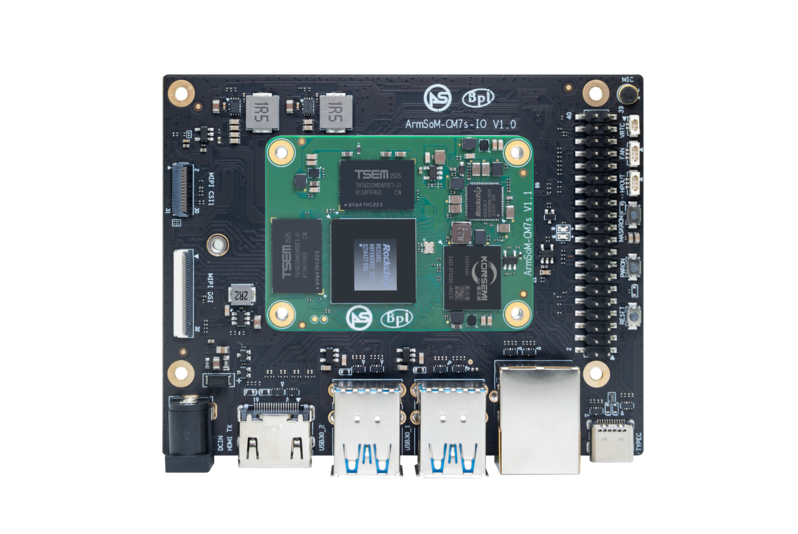
Build custom interfaces around an established compute module. The module provides the main processor, memory and storage functions; the carrier provides power and peripheral connections. Evaluate applications on a matching development platform, then design a dedicated carrier for your dimensions, connectors and mounting requirements.
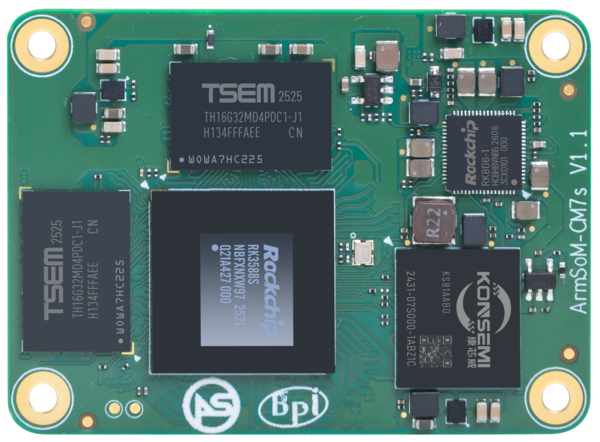
- CM / Compact board-to-board connection: for custom terminals and embedded devices, with CM1, CM3, CM5 and CM7S options for different computing needs.
- AIM / Socket-based modules: for modular smart devices, AI and multimedia applications, with platforms including AIM3, AIM5 and AIM7.
- LM / Soldered LGA integration: represented by LM7, for fixed-module designs with appropriate assembly, testing and rework processes.
CM5-IO, AIM-IO and the LM7-based W3 provide corresponding development and interface evaluation platforms. Check the specific module and carrier pin assignments, power requirements and software support before pairing them.
| ArmSoM-CM5 Rockchip RK3576 | ArmSoM-CM7S Rockchip RK3588S | ArmSoM-AIM5 Rockchip RK3576 |
|---|---|---|
 |  |  |
| ArmSoM-AIM7 Rockchip RK3588 | ArmSoM-LM7 Rockchip RK3588 | CM7S + CM7S-IO Rockchip RK3588S |
|---|---|---|
 |  |  |
| ArmSoM-CM5-IO CM5 Maker kit | ArmSoM-AIM-IO AIM Maker kit | ArmSoM-W3 LM7 Maker kit |
|---|---|---|
 |  |  |
Industrial Control Modules
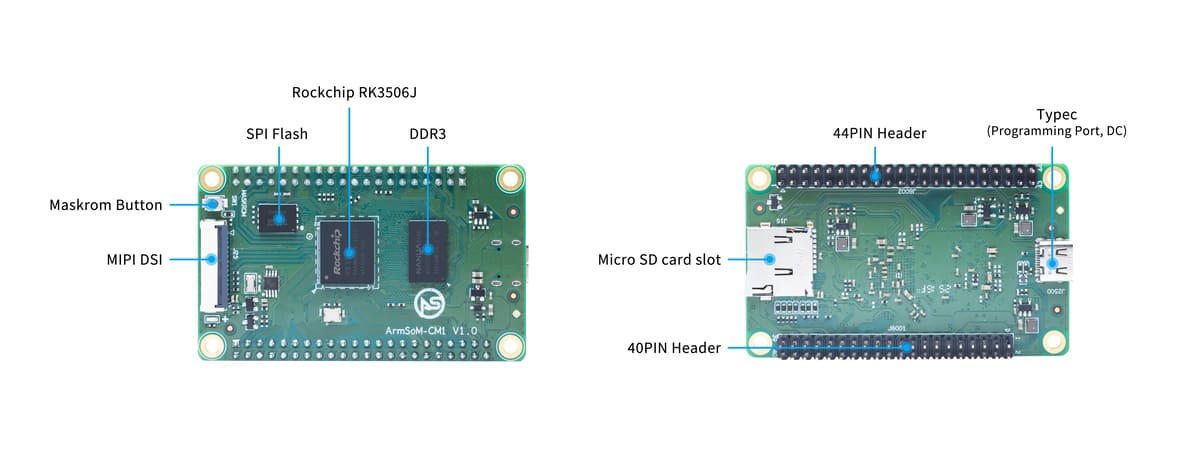
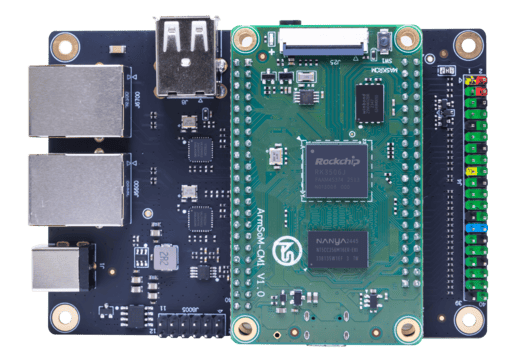
CM1 uses RK3506J for HMI, equipment control and industrial communication. Use CM1-IO for interface evaluation, then develop a dedicated carrier when integrating the module into your own equipment.
| ArmSoM-CM1 RK3506J compute module | ArmSoM-CM1-IO Carrier shown with CM1 |
|---|---|
 |  |
Forge Series Industrial Development Boards
Develop around equipment connectivity, control and HMI. Forge targets industrial gateways, operator interfaces and data acquisition. Choose based on communication interfaces, operating temperature and software support for your target system.
Forge1 uses RK3506J and provides industrial communication interfaces including RS485 and CAN. Its documentation specifies a −40°C to 85°C operating range. Use it to evaluate device protocols, display interaction and control applications; consider the CM1 module on the same processor platform when a custom hardware format is needed.
| ArmSoM-Forge1 |
|---|
 |
Accessories
Complete your platform with displays, cameras, cooling and enclosures. Select screens and cameras for the application, then choose cooling and mechanical accessories for the board and workload to build a practical prototype.
Check supported boards, pin assignments, cables, power and drivers before connecting accessories. A matching 40-pin header does not guarantee compatibility with every peripheral.
| ArmSoM Display 10 HD | ArmSoM Display 7 HD | ArmSoM Camera Module 1 | Active Cooling Kit | Sige DIY Case 1 |
|---|---|---|---|---|
 |  |  |  |  |
Product Catalog Table
| Sige Series Single-Board Computers | System on Module and Carrier Boards | IoT/Industrial Control | Accessories |
|---|---|---|---|
| ArmSoM-Sige1 [Rockchip RK3528] | ArmSoM-CM5 [Rockchip RK3576] ArmSoM-CM5-IO [CM5 Maker kit] | ArmSoM-Forge1 [Rockchip RK3506J] | display-10-hd |
| ArmSoM-Sige3 [Rockchip RK3568B2] | ArmSoM-AIM5 [Rockchip RK3576] ArmSoM-AIM-IO [AIM Maker kit] | ArmSoM-P2pro [Rockchip RK3308] | Camera-Module-1 |
| ArmSoM-Sige5 [Rockchip RK3576] | ArmSoM-AIM7 [Rockchip RK3588] ArmSoM-AIM-IO [AIM Maker kit] | ArmSoM-KVM [Rockchip RK3568B2] | Active Cooling Kit |
| ArmSoM-Sige6 [Allwinner A733] | ArmSoM-LM7 [Rockchip RK3588] ArmSoM-W3 [LM7 Maker kit] | ---- | Camera-Module-1 |
| ArmSoM-Sige7 [Rockchip RK3588] | ArmSoM-CM7s [Rockchip RK3588s] | ---- | Sige Diy Case 1 |
| ArmSoM-Sige7s [Rockchip RK3588s] | ---- | ---- | ---- |
Documentation Center
If you encounter any issues while using this documentation, please reach out to us via the forum or Discord, and we will respond promptly.
Join the Community
- Official Forum: ArmSoM Forum - The primary technical support channel, supporting both English and Chinese.
- Discord Community: ArmSoM Discord - A place where experienced users and the ArmSoM team are ready to assist you.
- Official GitHub: ArmSoM GitHub
Contact Us
Official Email: sales@armsom.org
Contribute
We warmly invite you to contribute to the ArmSoM documentation by providing feedback, submitting fixes, enriching the content, and showcasing your work.
About Us
ArmSoM was founded in 2021 by a team of passionate young developers driven by a shared enthusiasm for open-source innovation and freedom.
Initially established in Shenzhen, the company plans to relocate its headquarters to Singapore within the next three years to attract global like-minded talents.